
Alternative Everything
Fixation on safe, Christian alternatives gave us CCM, Testamints, and (maybe) a healthy skepticism of the link between power and goodness.

The morning of July 4th, I drove across the midwest with my husband—noting that all the corn is well past knee-high. We made it from Urbana, Illinois back to Des Moines in time for a family cookout. On the drive, we listened to some newly-discovered music: Real Face’s newest album, My Life is a Small Protest. It’s the most surprising, thought-provoking music I’ve encountered in a long time.
We were driving back from Audiofeed, a music festival that started in 2013, following the end of Cornerstone (the flagship Christian music festival started by Jesus People USA). I had never been to Audiofeed, but I did attend Cornerstone as a high schooler. My husband covered the festival for The Guardian in 2018.
This year, Kevin Schlereth (the festival’s current director) invited me to be one of the speakers; I decided to talk about the American evangelical affection for “alternatives.” It seemed like a fitting topic for a music festival dedicated to providing a space for independent and alternative Christian music and an audience that includes a lot of former evangelical youth group kids (like me).
I had the misfortune and good fortune of speaking directly after Andy Squyres , who is both funnier and more interesting than I am. Nonetheless, the crowd at Audiofeed was welcoming and engaging. I talked for a while—about Christian book stores and music departments, “safe” alternatives, parenting books, and cathedrals—and we had a great discussion after.
Here’s an excerpt from the talk I gave— about CCM, cathedrals, popularity, and power. I’m hoping to continue expanding and refining this, either for future presentations or a longer, written project. If you have thoughts, questions, ideas, pushback, I’d love to hear from you.
The American evangelical impulse to create alternatives has helped cultivate a thriving niche in the music industry, a growing faith-based film industry, and a publishing ecosystem. It’s easy to dismiss all of this as opportunistic marketing, blunt capitalism thinly disguised as ministry. But I don’t actually think that the evangelical love for alternatives is all bad.
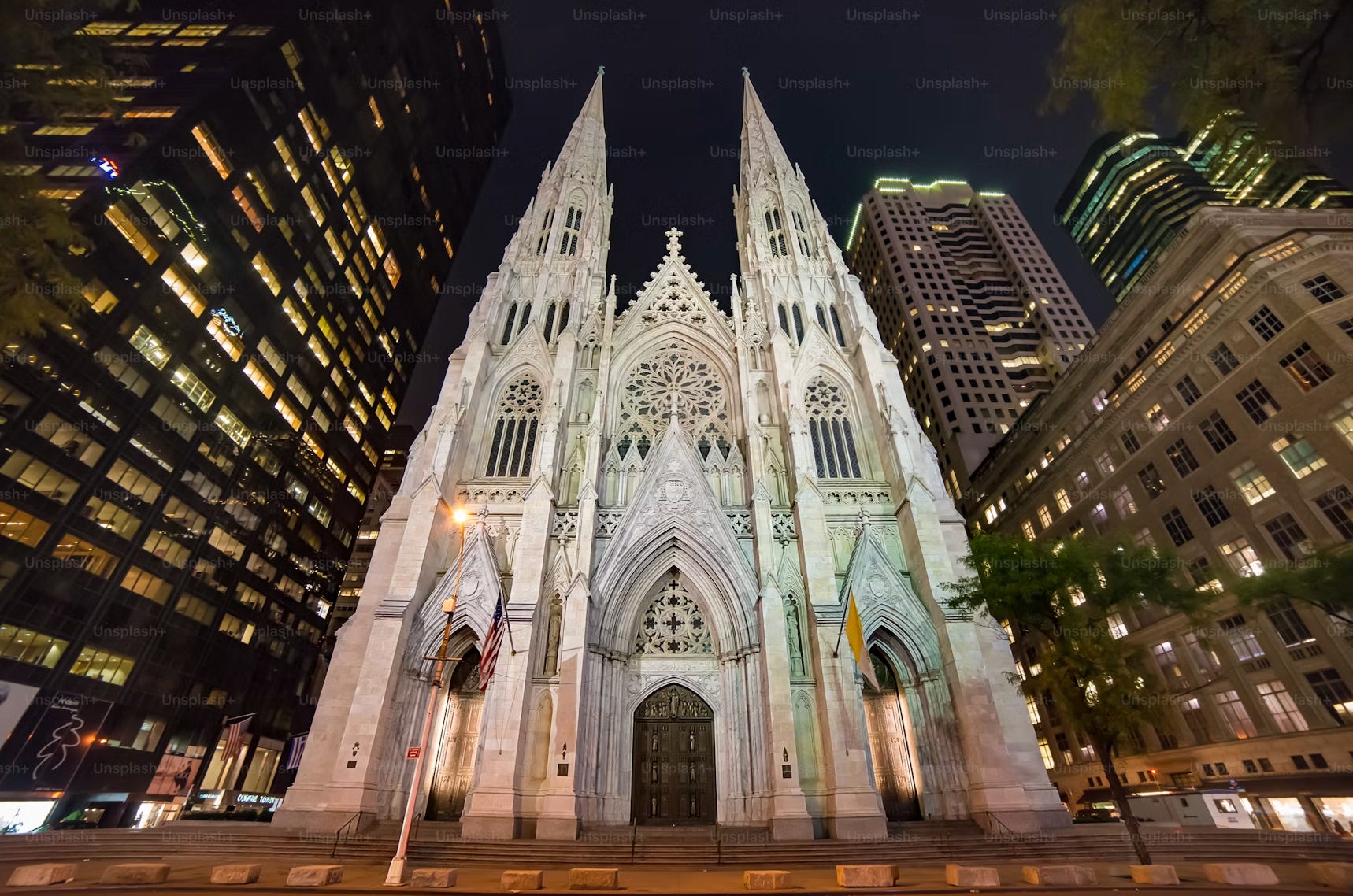
I often hear leaders who advocate for Christian hegemony talk about the beauty of cathedrals, and about the role of Christianity in providing the inspiration for some of the most valuable art and architecture in the Western world (JD Vance does this in his new memoir). They sometimes lament Europe’s gothic churches and the bygone era of Christian cultural dominance and power to shape the aesthetic world, and support the work of great artists.
There was a time when Mozart worked for the church. One of the most influential and innovative composers in the history of Western music once composed for Christendom. Shouldn’t we aspire to return to a time when the greatest artists wanted to work for the church and orient their music toward the worship of God?
Mozart didn’t want to be working for the church. He was looking for every opportunity to escape the constraints of composing for a church. What he really wanted was to be working on operas, the popular musical genre that rose to prominence in Italian courts as a musical spectacle designed to display wealth and political power. Opera, though, was notoriously expensive and fickle. A failed production could mean financial ruin for backers, and even with a composer as talented as Mozart, success was never guaranteed.
Mozart, like many other artists throughout history, wanted to create and push against existing boundaries of form and style. But he also needed financial stability. If the conditions had been right, economically, Mozart might have never written a mass or requiem.
Other major civilizations have beautiful architecture, awe-inspiring structures and art. If the religious landscape of medieval Europe had been different, cathedrals would have been constructed for other purposes. State power and narcissistic monarchs have long been able to summon artisans of all kinds to create, compose, craft for their glory.
Over the past year, there’s been a ton of reporting about the “explosion” of Christian music. There have been crossover successes, the niche is growing! American Idol had a worship night!
Sometimes, we misunderstand what cathedrals symbolize and romanticize the historical conditions that allowed them for the same reasons we get excited about the possibility that Christian music might be “taking over.” We mistake material power for the kingdom of God. Cathedrals are awe-inspiring. They are awe-inspiring because they are huge, they are artistic wonders, and it took lots of wealth and power to create them. But the kingdom of God does not require or follow wealth and power to flourish, or generate beauty.
The cooperation between Christianity, wealth, and political power during the medieval period gave us amazing art; but let’s not mistake scale for God’s presence or inspiration, or a healthy church. Similarly, we shouldn’t mistake publicity (or public fascination) for revival. When “Reckless Love” and “How Great Thou Art” show up on a reality show with millions of viewers, we are seeing a partnership between wealth, power, and Christian media.
When wealth and power share the stage with Christian art, it’s not cause for unqualified celebration. The kingdom of God is like a seed. And Jesus said to become like little children, not kings. Kings love to command artisans to create something awe-inspiring, something spectacular, something new, at their behest.
I laugh at the cringe behavior of my teenage self, high on my pretentious preference for alternative music and fashion (I was truly insufferable; I wore lenseless Buddy Holly glasses). But I think there’s always been something admirable about the underlying ideology of alternative music and culture, of the skepticism of popularity and widespread acclaim. There’s something Christlike, I think, about trying to uncouple commercial success from goodness. At its best, alternative culture compels us to guard ourselves against being convinced that wealth and power only share the stage with what is good, and that they will always seek out what is good.
The evangelical love of alternatives, when it’s not channeled toward creating fundamentalist fortresses (or faith-washed AI slop), can help create truly generative alternative spaces, scenes, and communities. It can help cultivate DIY music communities where art has value because of its humanity, not because of its scale. I think some of us experienced this in the Christian alternative scenes of the late ‘90s and early 2000s. They could be snobby and pretentious. But they could also cultivate in us an ability to appreciate human creativity in a relational way.
I’m not suggesting that cathedrals have no value. But there are soaring and ornate cathedrals and monuments constructed to honor the grand, the terrifying, the powerful, and of course, the good.
What if we reorient the search for “alternatives”? If we take out the fear and self-righteousness that sends us looking for separation, and the need for commercial validation that sends us running to the comment sections of American Idol clips... maybe our search for alternatives will lead us to become the kinds of urban gardeners God calls us to be. Maybe we will start cultivating seeds of the kingdom in the city God is building, rather than clamoring for the next partnership with power to build another cathedral.
Thanks for reading! As usual, here are a few recommended reads and listens:
This new song— “It is Good”—by Wendell Kimbrough and Fernando Ortega has been on repeat since last week. The orchestration is breathtaking.
This post by Oona Hanson about how diet culture is coming for young men is so, very needed. My forthcoming book focuses on diet culture’s impact on women, but there is a need for more acknowledgement of how the influencer-sphere and the wellness industry are hurting men as well. I’m grateful for Hanson’s voice and work. If you’re at all interested in an expert take on parenting and diet culture, I highly recommend her Substack.
Finally, I started reading The Black Cauldron by Lloyd Alexander aloud to my kids last week. It remains to be seen whether they are really that interested (they’re a little on the young side for this one, I think; my mistake). But I’m loving it. I haven’t revisited Lloyd Alexander since middle school, and if they don’t hang in there, I’m going to finish this one myself.
Hey Kelsey! This immediately made me think of this article https://livingroomdisciple.substack.com/p/maybe-christian-art-shouldnt-be-clean?r=7v60t6&utm_medium=ios
Philip does an amazing job talking about media that isn’t inherently part of the “Christian” genre but is created by and aligns with the values of Jesus.
As one of many musicians that owe much of my music education to the hard work from music ministries in houses of worship I have personally benefited from traditional church music. The church’s dedication to teaching reading and writing of Christian music taught me not only how to be a musician but also how to explicitly worship God through art.
The people who pursue “alt” versions of Christian music and those who drop the “Christian” label altogether (but make music as a Christian) are incredibly interesting to me. Is their “alt” nature a shunning of the popular sub genres already available? Is it an exploration of denying labels so that their creative expression cannot be pigeonholed?
Just some initial thoughts 💭 I agree that there’s much to be explored here!!!
Loved reading this—and thanks for the shout-out!